


Understand your organisation's access arrangements
Overview
NEIDAM will introduce a new organisation-level approach for managing access to AEMO market services.
A key change is the introduction of the System Access Organisation (SAO). This provides a structure for managing and overseeing access across Participant IDs (PIDs) at an organisation level.
Each System Access Organisation will also have at least one Organisation Administrator (OA) to oversee users and access across the organisation.
This page explains:
- what a System Access Organisation is
- how Participant IDs will be linked to a System Access Organisation
- the role of Organisation Administrators and Participant Administrators
- how arrangements work where another organisation manages access
- how authorised Service Providers fit into the NEIDAM model
System Access Organisations
What is a System Access Organisation?
An organisation that accesses AEMO’s systems that may be a Registered Participant or Related Entity to a Registered Participant (e.g. Service Provider) or regulatory organisation or public data access organisation.
Where:
Registered Participant is a NEM Registered Participant or NTEM Registered Participant or Gas Registered Participant.
Related Entity is a system access organisation, service provider or Disclosee, other than the Registered Participant, that is allowed access to the Registered Participant’s confidential information, AEMO market services and AEMO systems.
Public data access organisation is an organisation that pays fees to access public data using AEMO systems.
Regulatory organisation is a regulator, government department or agency who is permitted by legislation or other regulatory instrument or agreement to access a Registered Participant’s confidential information, AEMO market services and AEMO systems.
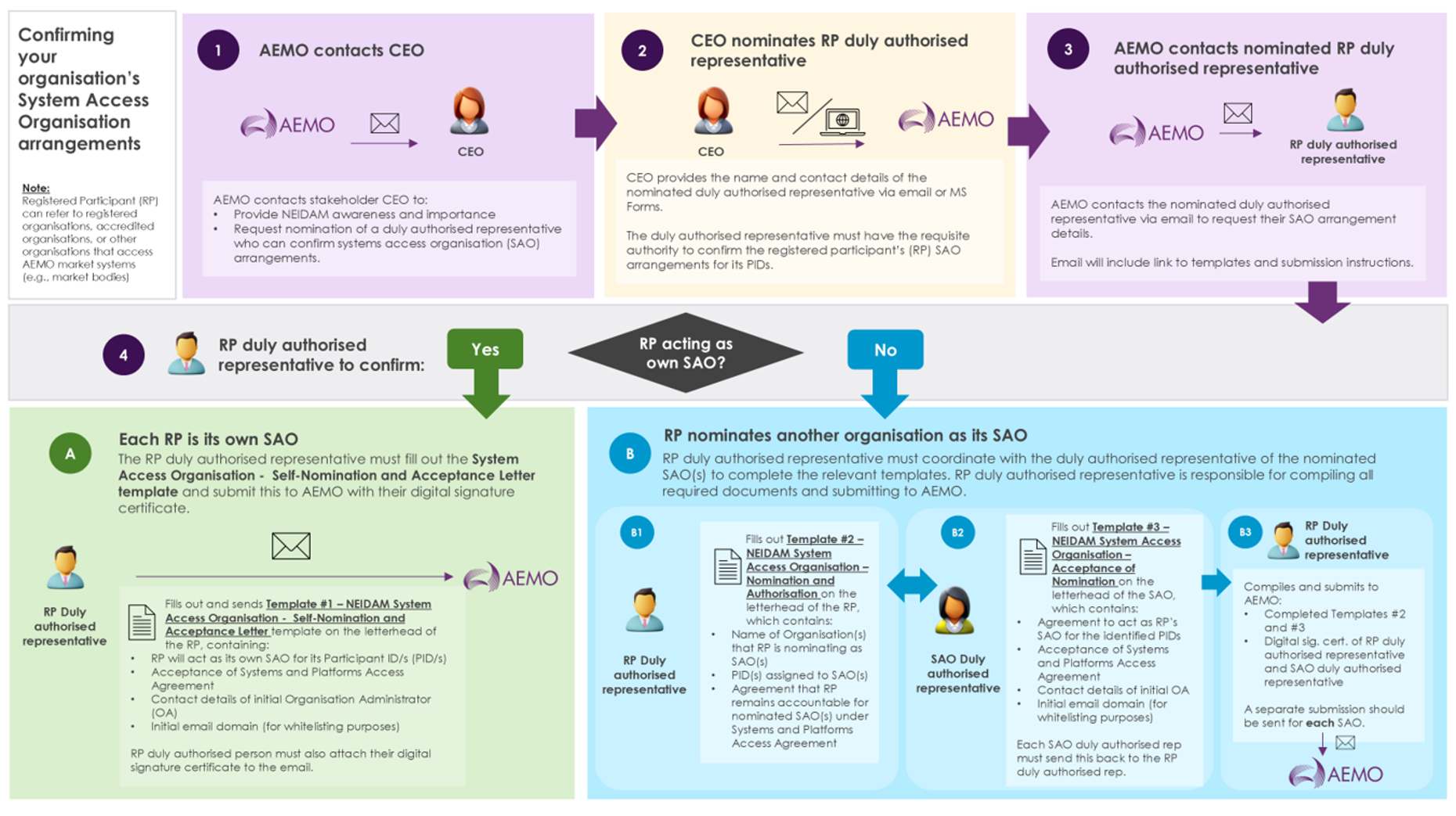
A Registered Participant may:
- act as its own System Access Organisation
- appoint another organisation to act as its System Access Organisation for one or more Participant IDs
- appoint more than one organisation to act as System Access Organisations across different Participant IDs.
A Participant ID can only be linked to one System Access Organisation.
Organisation Administrator
Each System Access Organisation must have at least one active Organisation Administrator (OA).
The Organisation Administrator provides organisation-level oversight of users and access.
An Organisation Administrator can:
- create and manage additional Organisation Administrators
- create and manage Participant Administrators
- create and manage users within the organisation
- oversee roles and access across the organisation
- manage the organisation's Segregation of Duties settings.
Each System Access Organisation must maintain at least one active Organisation Administrator to avoid disruption to system access.
Participant Administrator
The existing Participant Administrator (PA) role continues to support participant-level administration.
Under the NEIDAM model, a Participant Administrator can administer business users and rights for a participant, subject to the permissions provided by the Organisation Administrator.
The Participant Administrator will continue to play an important role under NEIDAM. However, the introduction of the Organisation Administrator creates a new level of organisation-wide oversight.
While the two roles work together to manage users and access, they operate at different levels and have distinct responsibilities. The table below provides a high-level comparison.
| Organisation Administrator | Participant Administrator | |
|---|---|---|
| Level | Organisation level | Participant level |
| Role under NEIDAM | New role | Existing role |
| Focus | Organisation-wide oversight of users and access | Administration of users and rights for a participant |
| Relationship | Can create and manage Participant Administrators | Operates subject to permissions provided by the Organisation Administrator |
Organisation email domains
As part of establishing a System Access Organisation, each organisation will need to nominate an organisational email domain, which will be used as the initial entry in the organisation's email domain whitelist.
The initial domain will be used to help associate user accounts with the correct organisation and ensure access is established for users with an approved organisation email domain. The initial Organisation Administrator's email address must align with that nominated domain.
Once the Organisation Administrator has been established, the Organisation Administrator will be able to maintain the organisation's email domain whitelist and add additional organisational email domains as required.